Vibe measurement
Start Omhoog


Vibration measurements on Neracar 

1.   Introduction
Since the Neracar engine of Ben Geutskens needed a new piston, there was an opportunity to apply a piston with a mass deviating from the mass of the original piston. Why one would consider doing so? Well, at certain RPMs engine and frame vibrated that strong that some doubt has been raised whether the balancing of the engine (from the twenties)  was optimal. Thus the idea has developed that application of a piston with an adapted mass might improve vibrational behaviour.
Unfortunately no such thing as an unambiguous recipe for balancing exists, so an approach has been adopted with experimental support, summarised as follows:

·          
determine vibrational behaviour for an engine with the original piston
·          
determine vibrational behaviour for an engine with the new, heavier piston
·          
conclude from the measurements whether the mass of the new piston shall be reduced
·          
conduct new measurements, etc.

What causes imbalance, how to deal with it, the justification for a heavier new piston and the calculation of the starting value for this heavier piston is outside the scope of this discussion. Ben has elaborated these issues in http://www.geutskens.eu/neracar/description6.htm). Neither are the results of the measurements discussed here: emphasis is on the measurement process.  

2.   Vibration sensor

Assessment of vibration calls for more than touching the vehicle and estimating the amplitude of vibration at a specific point of the structure: a sensor is needed that provides an output proportional to the subjected vibration, allowing for objective comparison of various configurations. It is common practice to use accelerometers for such purposes. Accelerometers are available in an abundance of sizes, ranges and qualities, however:
·          
standard sensors based on strain gauge or piezo techniques have their prices
·          
the (tiny) electrical signals produced by these sensors call for special equipment far beyond what even spoiled amateurs have on their shelves.
Fortunately nowadays virtually all smart phones, tablets and laptops are equipped with accelerometers to detect movements. These types of sensors  are not based on variation of resistance (strain gauges) or
electric charge (piezo), but detects deformation induced by acceleration forces though a differential capacitance measurement system. Built in signal conditioning circuitry comes standard. As a result of production on a single monolithic IC and wide application, costs have dropped to an attractive level. Depending on the type, acceleration is measured along one (X), two (X and Y) or even three (X, Y, Z) axes. As drawbacks shall be mentioned:
·          
limited choice in measurement range
·          
the small size calls for non standard soldering techniques
·          
the majority provides digital outputs which is convenient for digital processing in smart phones, tablets and laptops, but we prefer types with analogue outputs.  

We have opted for the ADXL203 family from Analog Devices, with the following characteristics:
·          
measurement ranges of +/- 1.7 g, +/-6 g and +/-18 g
·          
independent measurement along X- and Y-axis; this is of importance, since balancing not only involves vibrations in the direction of the stroke of the piston, but also sideways perpendicular to the crankshaft
·          
easy selection of bandwidth through external capacitors
·          
an LCC-8 package, just manageable with a soldering iron.  

Based on figures provided by Ben as to maximum RPM and relevant engine geometry it was estimated that maximum values due to imbalance would not exceed 0.3 g. Thus the choice for a sensor with a measurement range of +/- 1.7 g seemed the obvious one. This sensor features a sensitivity of 1000mV/g.

The Neracar engine will not exceed 500 RPM. This corresponds with a frequency of 8.3 Hz. From the datasheet of the ADXL203 it can be deduced that with an external capacitor of 0.22 μF higher frequencies are effectively blocked.
One additional capacitor is needed: to decouple the sensor from noise on the power supply line. This capacitor must be located close to the sensor.


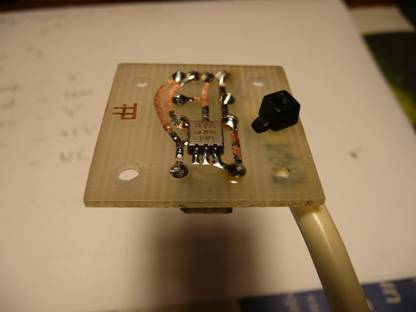
Sensor and capacitors have been mounted on a PC board of 30 x 30 mm. The sensor is mounted on the copper side of the print, the capacitors are mounted on the other side, as is the cable that connects the print to the 5V power supply for the sensor and the dual channel oscilloscope.

 3.   Measurement set-up
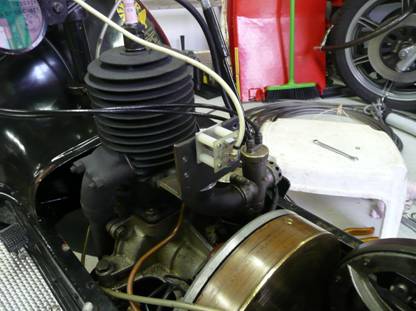
The print has been mounted on an Alu plate, using M3 bolts with spacers. The plate was firmly attached to a steel bracket bolted to the engine block. The orientation of the print was such that, with the oscilloscope in X-Y mode and X- and Y-signal from the sensor connected to (horizontal) X-input and (vertical) Y-input respectively the movements of the print were followed by the spot on the display of the oscilloscope.
Since the X-axis of the sensor is pointing horizontally, the X-output of the sensor is not affected by gravity. In absence of any vibrations of the engine the X-output yields a static 0 g. The Y-axis, however, is pointing vertically, so gravity induces an offset of 1 g in the Y-signal.
The movements of the spot on the display of the oscilloscope as a result of engine vibrations have been recorded with a digital SLR camera, on a tripod in front of the display of the oscilloscope, with a 1 second exposure time to collect acceleration data over several engine cycles.


4.   The first test results
As mentioned before, at certain engine RPMs a clear vibration of engine plus frame was experienced. This behaviour was confirmed by the accelerometer signals from the sensor. According to the pictures from the moving spot on the display of the oscilloscope the movements were predominantly in the (horizontal) X-direction. Since this was more or less confirmed by what was ‘measured’ by hand, we were initially inclined to believe that what was presented on the scope was correct. 

What spoiled the feeling of satisfaction was that two anomalies were observed for which no explanation was available:
·          
As soon as the engine was started, the Y-signal showed a shift in positive direction, which could not be attributed to drift effects of the scope.
·          
With the engine off, tapping the print (and the sensor) in Y-direction resulted only in changes of the output in positive direction.

 5.   Analysis
It took a while before it was recognised that both effects could be caused by vibration levels in a frequency range well above the frequencies that pass the low pass filter in the output signals, especially if these vibration levels lead to internal saturation (clipping).
To verify whether the presence of higher frequencies indeed spoiled the beans the following adaptations have been made to the electrical circuitry:

·          
The condensers that determine the bandwidth of the low pass filters in the output signal paths were adapted to enable monitoring of vibrations with frequencies up to the limit of the ADXl203 sensor (2.5 kHz). This comprised replacement of the initially installed condensers of 0.22 µF on the print by species of 2.2 nF.
·          
An external switch was installed that enabled to switch back to the original configuration with the limited bandwidth that blocked all frequencies above the crankshaft range.

 With the switch in the ‘high’ position, the presence of higher frequencies was confirmed: operating the foot starter already showed an abundance of vibration signals had had been invisible earlier. With the engine running the amplitudes of the higher frequencies increased to a level where, for both X- and Y-signal, clipping appeared.

 In a simulation program the presence of high-level vibrations in a frequency range far above the frequency of interest has been investigated. This exercise provided numerical proof that, due to clipping effects induced by the disturbing vibrations, considerable measuring errors are introduced for the low-level low frequency signals we are interested in.

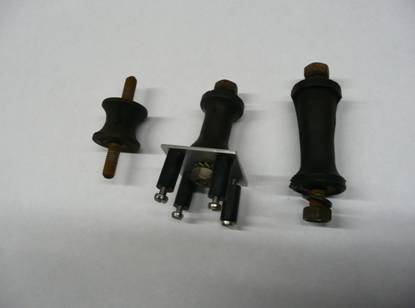
 A quick attempt has been made to suppress the disturbing high frequencies by applying a mechanical filter. The underlying idea was to isolate the sensor print for high frequency vibrations through the application of a low pass mass-spring system: a vibration damper. Available types  were from the automotive field.


Though the transmission of the higher frequencies was indeed suppressed noticeably, uncontrolled movements in the frequency range of interest necessitated to drop this quick and dirty solution. 

What remained was to face facts: the selected sensor was not appropriate for the application at hand. A sensor was needed that could withstand the disturbing vibrations without clipping. 

6.   Second attempt
In the rebound a sensor from the same family as the original ADXL203 was applied: type AD22037 with a range of +/- 18 g. Since the delicate soldering of the sensor excluded simple replacement of the sensor on the print, a new print was produced for the second sensor. To allow monitoring the outputs of the sensor over the full frequency range (2.5 kHz), condensers of 2.2 nF are mounted on the print. Identical to the earlier used set-up, an external switch enabled the bandwidth to restrict to 25 Hz , the frequency range of interest for the balancing experiments. 

The test results for the AD22037 looked fine: with the switch in the ‘high’ position no longer clipping effects due tot the disturbing higher frequencies, with the switch in the ‘low’ position a normal response to tapping of the sensor.  

The fact that the (10 times) wider measuring range of the AD22037 had to be paid by a proportionally lower sensitivity – merely 100 mV/g instead of 1000 mV/g for the original ADXL203 – could easily be compensated through adjustment of the settings of the scope. 


Rob Poestkoke

3-3-2015